The India Story Is Not About Speed
It is about an economy that kept compounding through crisis, reform, neglect, and noise.

BYLINE PLACEHOLDER
Founder, Opulence International Wealth Managers

I started this business in 1992.
If you were not in India then, the small details explain the country better than any chart. The country had nearly run out of foreign exchange the summer before. We had airlifted gold to London as collateral. A colour television was a status symbol. Getting a telephone connection could take years, and a scooter came with a waiting list.
The idea that an Indian company might one day be worth a hundred billion dollars would have sounded unreal.
But thirty-four years later, I manage money for families whose grandparents I first met in that decade. And people often ask me what surprised me most about the journey and they expect me to say the speed.
It wasn’t the speed.
What actually surprised me
Here is India’s average annual real GDP growth, decade by decade: about 5.7% in the 1980s, 5.8% in the 1990s, 6.3% in the 2000s, 5.5% in the 2010s, and roughly 7.8% since 2020. Real GDP means economic growth after removing inflation, so you are looking at actual output, not just higher prices.
Now look at what those decades contained. A balance of payments crisis that nearly bankrupted the country. Nuclear tests and international sanctions. The Asian financial crisis. The dot-com bust. A global financial crisis. Demonetisation. GST. A pandemic. Two wars that reshaped global energy markets. A trade war.
Through all of it, the number barely moved.
That is the thing it took me twenty years to properly appreciate. India does not grow fast as much as it grows anyway. The headlines change every few years, and the growth rate mostly ignores them.
This is not luck, and it is not patriotism talking. It is structural. India’s growth is not built mainly on exporting goods to someone else’s consumer, and it is not built on selling oil or metals. It is built on Indians buying things
from other Indians.
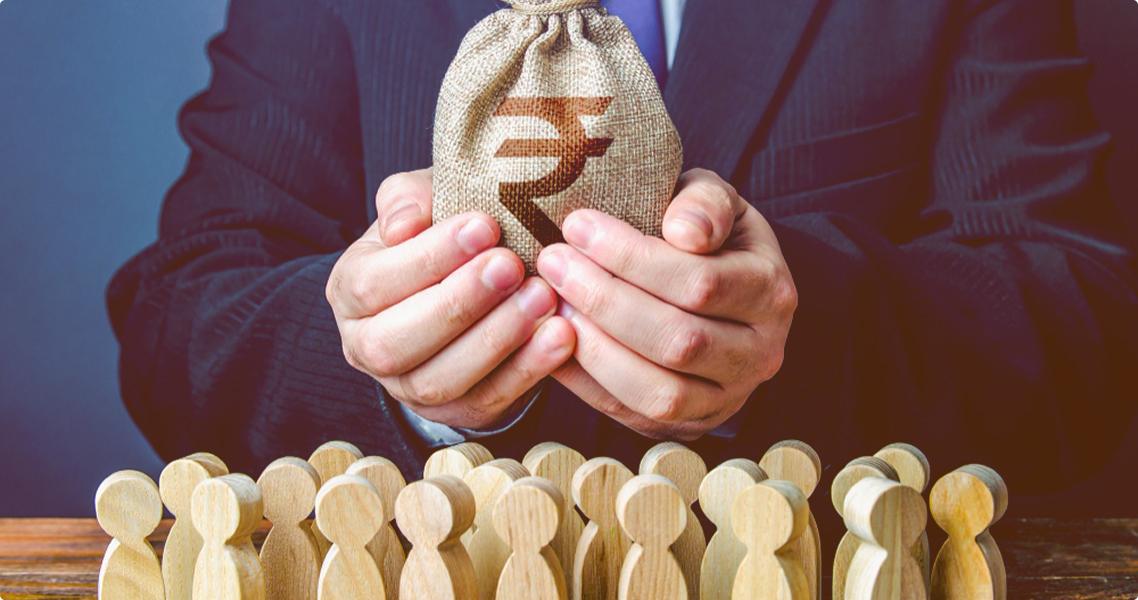
Private consumption reached about 61% of India’s GDP in FY25, a two-decade high. Private consumption simply means household spending: food, housing, travel, healthcare, education, phones, vehicles, insurance, and everything else families buy.
Compare that with an export-led model, where a recession in your buyer’s country can become a recession in yours. A domestic-demand economy has a shock absorber built into it. That is why India’s real GDP growth has been less volatile than almost every other major emerging economy over the past
four decades.
If you are an investor, low growth volatility matters. Volatility means how much something swings around. A country that grows steadily gives businesses, lenders, and households more room to plan.
The engine, and how early it still is
So the engine is the Indian consumer. The question every serious investor should then ask is: how much of that engine has already run?
Far less than most people assume. Some numbers still make me pause, and I have been looking at them for years.
Cars. India has roughly 44 cars per 1,000 people. China has around 310. The United States has about 850. Put differently, India’s National Family Health Survey found that only about 8% of Indian households own a car, while 54% own a two-wheeler. An entire country of families is sitting one income bracket away from their first car.
Air conditioning. Around 5% of Indian households have an air conditioner. In China it is roughly 60%. In the United States and Japan, around 90%. This is in a country where large parts of the population endure 45-degree summers. Annual room AC sales in India went from about 1 million units in 2006 to over 11 million by 2023, and that is still only 5% penetration.
Everything else. Urbanisation is around 35%, against 63% in China. Health insurance, organised retail, branded apparel, air travel, mutual fund ownership: the penetration numbers across almost every discretionary category sit in single digits or low double digits. Penetration means how many people or households already use a product or service.
These are not signs of a market that has matured. They are signs of a market that still has a long runway.
The megatheme: the pyramid is becoming a diamond
Here is what pulls those penetration numbers up, and it is the single most important structural trend I have watched in my career.
In 2005, roughly 69% of Indian households were classified as low income, meaning households spending mainly on food and essentials. Bain and the World Economic Forum project that by 2030 India’s household income profile stops looking like a pyramid and starts looking like a diamond: around one in two households in the upper-middle and high income brackets, up from one in four. Some 140 million households moving into the middle class, and another 20 million into high income.
Their estimate is that consumer spending rises from roughly $1.5 trillion to nearly $6 trillion, making India the world’s third-largest consumer market.
I want to be careful here, because projections are projections and I have seen plenty of them fail. But the mechanism underneath this one is not speculative. It is arithmetic that has already partly happened.
When a household crosses from ₹3 lakh to ₹8 lakh of annual income, its spending does not rise proportionally. It changes shape. Food’s share falls. The first two-wheeler becomes the first car. The first air conditioner arrives. Health insurance gets bought. A child goes to a private school.
Bain’s estimate is that these households spend two to two-and-a-half times more on essentials and three to four times more on services. That non-linearity is the whole opportunity. Non-linearity simply means the outcome does not move in a straight line. A little more income can create a much larger change in behaviour.
And with India now the world’s fourth-largest economy at around $4.2 trillion, and most forecasters expecting third place and roughly $7 trillion around 2030, the base it operates on keeps getting bigger.
The digital layer sits underneath all of it. UPI processed 21.6 billion transactions in December 2025 alone, around 228 billion for the year, roughly 85% of India’s digital payments and close to half of all real-time digital payments on earth.
A payments rail that did not exist in 2016 now reaches a street vendor in a town I had never heard of. That is what made the consumption economy formal, and therefore investable.
What this has meant for capital
Now the part that matters to you as an investor.
The Sensex started in FY1979 at 100. It ended FY2025 at about 77,400. That is a compounded price return of roughly 15.6% a year over 46 years, turning 100 into more than 77,000, about 22 times what the same money would have made in an 8% fixed deposit. A price return means this looks only at index price movement, not dividends.
But the long-run number is not what I would put in front of you. This is:
I ran every overlapping holding period in that 46-year history. Over one year, the Sensex lost money in 14 of 46 periods, nearly a third of the time. Over five years, three out of 42. Over ten years, one out of 37.
Over fifteen years and longer: not once. In 32 overlapping 15-year periods and 27 overlapping 20-year periods, there was no losing outcome. The worst 20-year stretch in Indian equity history still compounded at about 7.3% a year.
India has never been a market that rewards impatience. It has been remarkably reliable at rewarding patience.
The honest part
If I stopped there, I would be selling rather than speaking the truth, so let me tell you what the last eighteen months have actually looked like.
They have been poor. Indian equities have been largely rangebound while emerging markets broadly and China specifically have run well ahead. Foreign investors have been net sellers through the longest sustained outflow phase in about two decades. The rupee weakened again. Small and mid caps, where a great deal of retail money crowded in after 2020, gave back a lot of ground. Roughly half the mainboard IPOs of the last two years are trading below issue price.
None of that is comfortable, and anyone who tells you otherwise is not being straight with you.
But I have sat through 1992, 2000, 2008, 2013 and 2020, and I will tell you the pattern I have observed, with the caveat that patterns are not guarantees. The moments when India felt most obviously investable, 2007, 2021, were usually the worst moments to commit fresh capital. The moments when it felt tired and unloved were usually the best. The expensive valuations of 2024 have corrected largely through time rather than through a crash, which is the gentler way for it to happen.
I cannot tell you the next two years will be good. I can tell you that my thirty years suggest buying India when it is out of favour has worked considerably better than buying it when it is celebrated.
And I would separate two things that get confused constantly:
the Indian economy, which has compounded with remarkable consistency, and the Indian market, which swings between euphoria and neglect around that line. Your returns depend enormously on which of those two you are actually paying attention to.
Where that leaves you
If you are an NRI or a global investor considering India, my honest view is this.
India is not a tactical trade. It is not something to buy because a headline is good or avoid because the last eighteen months have been uncomfortable. It is a long-term allocation to a large emerging consumer base, at a stage of penetration that is still early, with a growth pattern that has been unusually steady through many shocks.
That does not mean you put any money in blindly. It means you size India to your horizon, your risk tolerance, your currency needs, and your ability to sit through bad periods without being forced out.
Thirty-four years ago I could not have told you India would get here. What I can tell you is that in all that time, the people who did best were not the ones who timed it. They were the ones who stayed.

Sources and notes
- Decadal real GDP growth and inflation: IMF; Reserve Bank of India.
- Private consumption at 61.4% of nominal GDP in FY25, a two-decade high: Ministry of Finance monthly economic review, June 2025.
- India as fourth-largest economy at approximately $4.2 trillion, with third place and roughly $7.3 trillion projected around 2030: IMF World Economic Outlook; S&P Global Market Intelligence; Government of India Press Information Bureau.
- Household income profile shifting from pyramid to diamond by 2030; 140 million new middle-class households; consumer spending rising from approximately $1.5 trillion to nearly $6 trillion: Bain & Company and World Economic Forum, Future of Consumption in Fast-Growth Consumer Markets: India.
- Vehicle ownership per 1,000 people: Council on Energy, Environment and Water (CEEW); household car and two-wheeler ownership: National Family Health Survey. Air conditioner household penetration and unit sales: International Energy Agency; Bureau of Energy Efficiency.
- UPI transaction volumes and share of digital payments:
National Payments Corporation of India, December 2025 data. - Sensex financial-year-end values, FY1979–FY2025: BSE. Rolling-period return analysis computed from that series. Returns are price returns, gross of dividends, tax and costs.
In USD terms: rupee depreciation has averaged roughly 3–4% a year against the dollar over the past two decades, so dollar-denominated returns on Indian equities have run correspondingly below the rupee figures quoted above. For investors accessing India through a GIFT IFSC structure, returns are reported in foreign currency and this effect is explicit rather than hidden.
This article is for educational purposes only and does not constitute investment advice or a recommendation to buy or sell any security. Past performance is not indicative of future results, and long-term historical patterns offer no guarantee of future outcomes. Index returns are not directly investable and do not reflect fees, expenses or taxes. Projections cited are those of third parties and may not materialise. Opulence International Wealth Management (IFSC) is a distributor of financial products and is not a registered investment adviser. Please consult a qualified professional before making any investment decision.</i >